Turning a press app’s empty Explore tab into a daily edition that broadens what subscribers read.
Client
Cafeyn
year
2026
role
Product Design - UX & UI - Product strategy

Project Description
Cafeyn gives subscribers unlimited access to 1,600+ newspapers and magazines. Its own data shows that readers who discover more titles stay longer. Yet most subscribers read the same two or three, and the Explore tab built to change that sits nearly empty.
The interesting part was that Cafeyn had already solved half the problem without noticing. Daily Digest, a dated and finite edition on Home, proves readers will open a short, curated selection every day. It was simply pointed at catching up on the news, never at broadening what people read.
In a six-hour design challenge, I reframed discovery from a place you visit into a ritual you keep. L’Édition is a finite daily edition that starts from your taste and deliberately leans a little beyond it, with a reason behind every pick. It reaches readers where they already are: a row on Home, the moment they finish an article, and a weekly recap that shows how far their reading has travelled.


Type
Concept · design challenge
Team
Solo
Timeline
6 hours · July 2026
Platform
iOS · Android
Tools
Figma · Cafeyn brand tokens · Claude
00 · Overview
Problem
Discovery drives retention, but Explore is a flat wall of identical article cards. Subscribers open it once and never come back.
What I did
Took the finite edition Cafeyn already ships and pointed it at discovery. Designed one engine with four touchpoints, the rationale line, and the metrics to prove or kill it.
Result
Presented to Cafeyn’s Product Director and design team, and it moved me forward in the process. Not shipped.
Concept · not shipped
Six-hour solo design challenge for Cafeyn, July 2026. Built on the public app and the brief’s own data. The persona and reading data are illustrative.
01 Context
02 Insights
03 Reframe
04 Explorations
05 Structure
06 Solution
07 Measuring success
08 Reflection
01 · Context
Cafeyn had already built the perfect discovery object. It was aimed at the wrong job.
For the business
For the owner
Constraints
6 hours, solo
Cafeyn’s brand system
Publishers’ own formats
A calm, older audience
No access to user data
02 · Insights
Jobs to be done
Insight 01
Nothing makes you come back.
Explore shows only articles, never magazines. Identical cards, no personalisation. One scroll is enough.
Source · App audit
Insight 02
No reason, no trust.
Nothing tells readers why a title is there, so they scroll past. Unexplained suggestions train people to ignore suggestions.
Source · App audit · JTBD
Insight 03
The best moment is wasted.
Readers finish an article they loved and the app offers nothing. The highest-intent moment in the product is a dead end.
Source · App audit
Meanwhile, Daily Digest, a dated, finite, algorithm-driven edition, already lives on Home. It proves the format works. But its job is catching readers up, never broadening them.
“I know what I like to read. If you think I should read something else, tell me why.”
Jean Moreau · proto-persona, subscriber for 3 years, Lyon

Jean Moreau · 45, project director
Proto-persona
Subscribed for two titles; he knows there are 1,600 others and has opened five. 7:15am, coffee, twelve minutes before the kids come down. If something is going to reach him, it’s in that window.
The ritual
“Help me keep my morning ritual effortless.”
The next read
“When I finish something good, tell me what to read next.”
The reason
“If you suggest something new, tell me why.”
03 · The reframe
Principle 01
Every pick explains itself
If the system can’t say why it chose something, it doesn’t choose it. One recommendation, one reason, one line.
Principle 02
The comfort zone is sacred
His favourite titles never leave the top of Home. Discovery pays rent one row down.
Principle 03
Finite over infinite
An edition ends. That’s exactly why he comes back tomorrow. No streaks, no FOMO, no infinite scroll.
04 · Explorations
Four directions, judged on one question: does it work for Jean at 7:15am? Two survived, together.

REJECTED
Fix the destination
A better browse surface. A prettier grid doesn’t answer why Jean would ever go. The problem isn’t the shelf, it’s the trip to the store.

REJECTED
Go feed-first
An article-level vertical feed. It fights the brand’s calm, the audience’s age and the publishers’ formats. It optimises minutes, and minutes aren’t the prize.

KEPT
Dissolve into the flow
Discovery at the moments of real intent: end of read, Home, a weekly recap. Alone, it sparks appetite with no home for the habit.

KEPT
Make it a ritual
Point the proven edition format at discovery. Alone, nothing drives traffic to it, which is the current state. Together, they fix each other’s flaw.
Three bets I designed against, each cheap to test and safe to lose
It’s sameness, not reluctance
Test: a dated edition as a fake door against the current feed. If wrong, the concept dies in two weeks for the price of a prototype.
End of read converts best
Test: taps to first read across the three placements. If wrong, cut the card, keep the edition, lose nothing.
05 · Structure
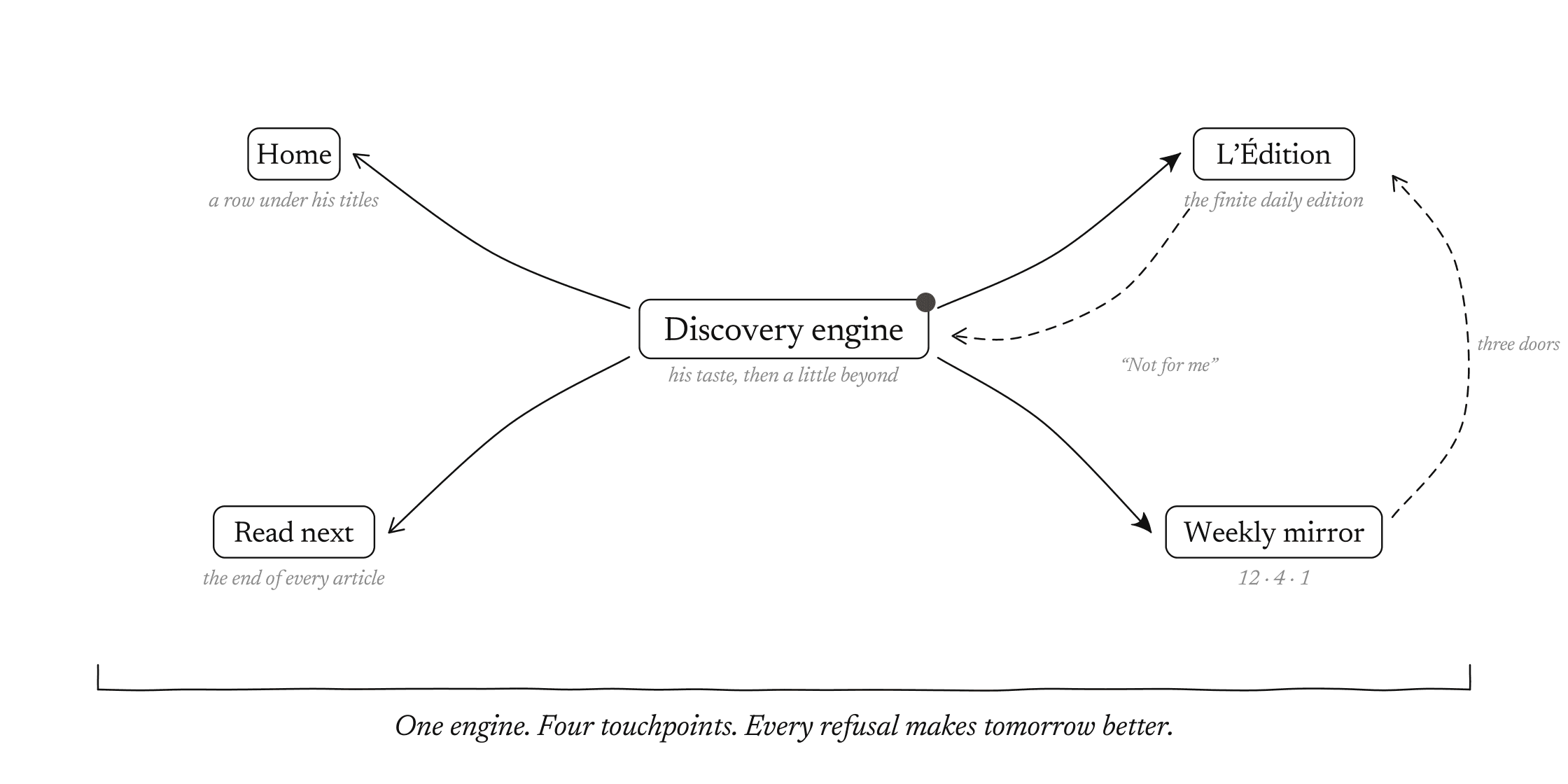
One engine. Four touchpoints.
States and edge cases

No reading history yet. The edition leans on declared interests and says so.

“That’s all for today.” A calm end, his titles one tap away, no padding.

The pick steps back and trains tomorrow’s edition. A refusal is input, not a dead end.

The weekly mirror shows 0 without guilt and offers three new doors instead.
06 · Solution
The entry point
Discovery earns a row on the screen he already opens.


1
His favourite titles keep the top slot. The ritual that pays the subscription is never demoted.
2
“Your edition of the day · 3 reads chosen for you” sits one row down. Discovery starts where Jean already is, not in a tab he has to remember.
3
Daily Digest stays exactly as it is. Catching up and broadening are different jobs.
L’Édition
Mostly his taste. Deliberately, a little beyond.


1
The date is the title. Fresh, finite, different tomorrow.
2
Descending confidence: his interests, then the morning’s moment, then openly “Far from your habits”. The 30% beyond his taste is named, not hidden.
3
Every pick carries its reason and a “Not for me” exit. The edition ends, and that ending is the reason to come back.
Read next
The highest-intent moment, no longer a dead end.


1
One card, never a feed. The best next read, already chosen, not ten options asking him to choose again.
2
The reason travels with the suggestion. Same voice as the edition, same trust.
3
Ignored or refused, it steps back and trains the engine. Restraint is what earns it the right to come back.
The weekly mirror
Breadth, shown as progress he can feel.
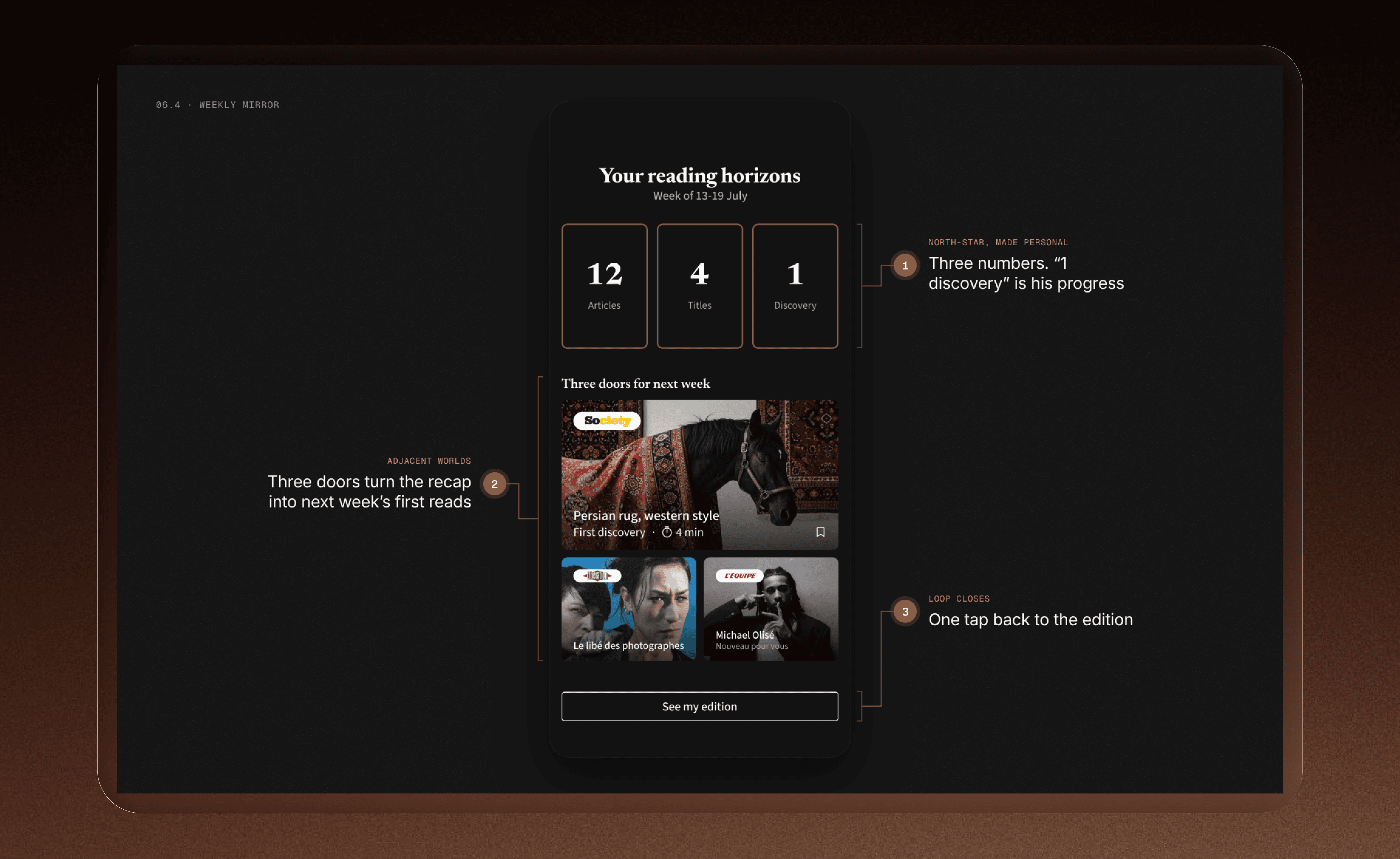
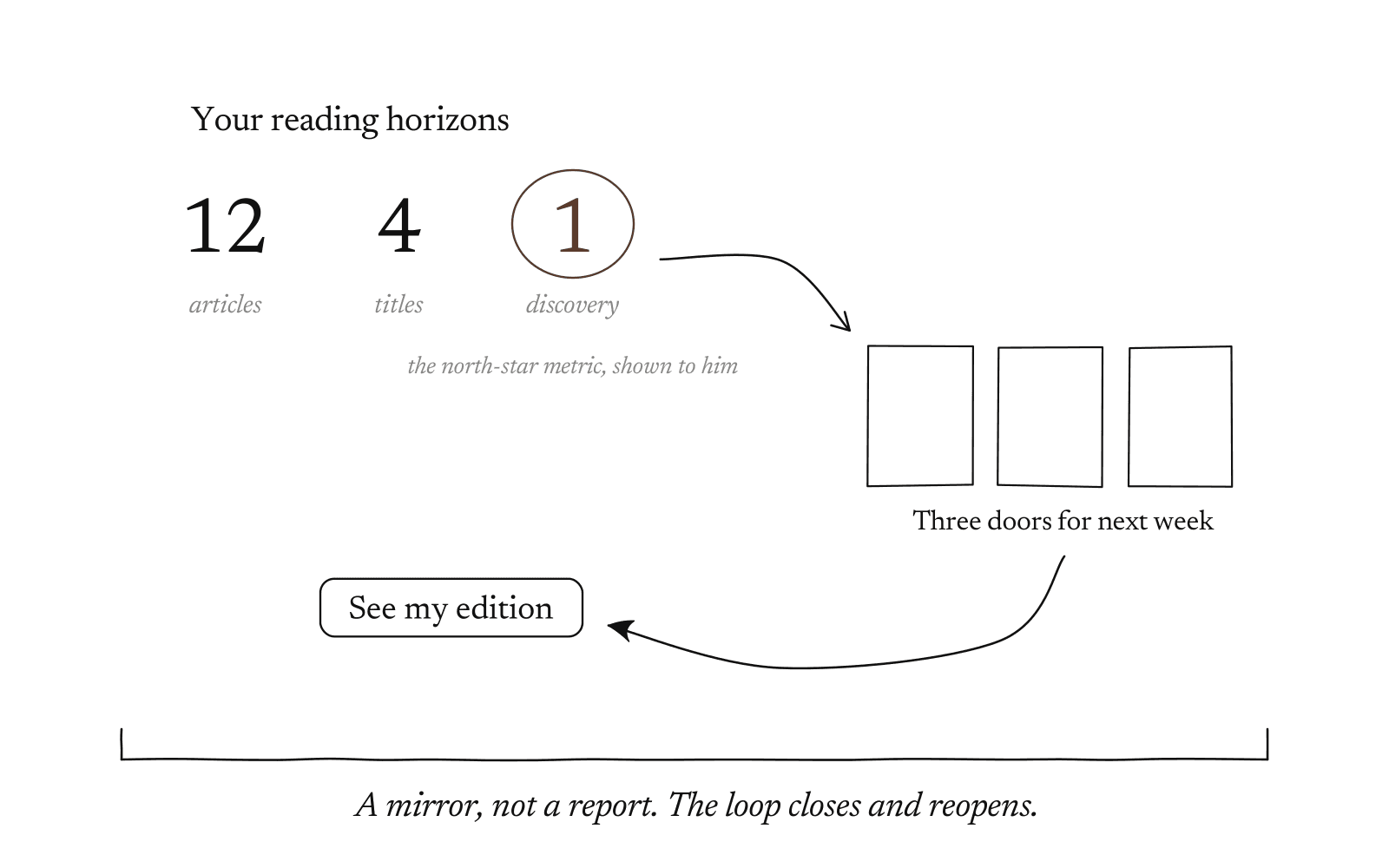
Three numbers, no report. “1 discovery” is the product’s north-star metric, shown to Jean as his own progress. Three doors into adjacent worlds turn looking back into next week’s first reads. One tap hands him back to the edition. The loop closes and reopens.
07 · Measuring success
Two numbers, one bet.
North-star
Breadth rate
Share of monthly readers who open a title for the first time. The engine’s one job, measured directly.
Guardrail
Favourite-title engagement
Weekly reading frequency of followed titles. Proof that discovery never cannibalised the habit that pays the subscription.
First test
Retention
Cafeyn’s data already links breadth to retention. I don’t need to claim it; I need to feed it.
THE TRADE-OFF
08 · Reflection
What I would do next
Talk to real readers, in both brands
Jean is a hypothesis. A Cafeyn reader isn’t a Readly reader; rhythms and loyalty differ. I’d validate before rolling out across 15 countries.
Design the edges
The prototype shows the ideal morning. The first edition with no history, the edition finished by 8am, the week with zero discoveries: that’s where trust is won or broken.
The bigger bet
Home is causing the problem
Home leads with “Your favourite titles”: publications, not stories. Every session replays the same two-title loop. The product teaches narrowness, then asks a dead tab to cure it.
Make Home story-first
Open with the day’s best reads filtered by interests, with favourite titles one row down as a fast lane. Shippable behind a holdout group, with the ritual always one tap away.
Credits
Solo design challenge for Cafeyn, July 2026
Persona and reading data are illustrative
Magazine covers belong to their publishers