Helping restaurant owners know, in under a minute, if tonight was a good night.
Client
Sunday
year
2026
role
Product Design - UX & UI - Product strategy

Project Description
Sunday lets restaurant guests pay at the table with a QR code. Behind it sits a merchant dashboard where owners track payments, tips, reviews and staff. As a three-day product design challenge, I redesigned what that dashboard shows the moment an owner logs in.
The dashboard already had the data. What it lacked was an opinion. For an independent owner closing up at 11:30pm, a homepage of equal-weight charts answers nothing, and a tool that answers nothing is a tool she stops opening. For Sunday, this is the one screen that talks to the owner rather than the guest.
I rebuilt the homepage around the three questions every owner asks after service: was tonight good, does anything need me, and what should I do tomorrow. The result is a three-zone homepage, built on MUI inside Sunday’s existing navigation, that gives a plain-language verdict, ranks what needs action before close, and turns tonight’s data into one recommendation for the next service.


Type
Concept · design challenge
Team
Solo
Timeline
3 days · May 2026
Platform
Web · desktop and iPad
Tools
Figma · MUI · Figma Make · Claude
00 · Overview
Problem
Owners log in after service to a homepage that shows everything with equal weight. They leave without knowing if the night went well.
What I did
Reframed the homepage from a report into a verdict. Designed the three-zone structure, the urgency system, the assistant’s verdict copy and an end-to-end prototype.
Result
A homepage that answers three questions in reading order, in under a minute. Not shipped: the next step is validating it with owners at close.
Concept · not shipped
Three-day solo design challenge for Sunday, May 2026. Built on the structure of Sunday’s existing merchant dashboard. The restaurant, persona and figures are illustrative.
01 Context
02 Insights
03 Reframe
04 Explorations
05 Structure
06 Solution
07 Measuring success
08 Reflection
01 · Context
Sunday captures every number a restaurant produces. The homepage didn’t say which ones mattered.
For the business
Working assumption, not Sunday data
For the owner
Constraints
3 days, solo
MUI component library
Keep Sunday’s existing navigation
Desktop and iPad
No access to real merchant data
02 · Insights
Dashboard audit
End-of-service timeline
Jobs to be done
Competitor scan
Insight 01
Rich data, no hierarchy.
Twelve navigation sections and a homepage of equal-weight widgets. Nothing tells the owner where to look first, so she looks everywhere or nowhere.
Source · Dashboard audit
Insight 02
The real moment is 11:30pm.
The dashboard is opened after the last table leaves: tired, on an iPad, with twenty minutes to spare. Design for that moment, not for a Monday-morning analysis.
Source · End-of-service timeline
Insight 03
She wants a verdict, not a chart.
Revenue up or down, covers hit or missed. One clear signal that tells her if tonight was worth it, before she lets herself switch off.
Source · Jobs to be done
“I just need to know if we had a good night, and whether we’re heading in the right direction.”
Marie Amrani · proto-persona, owner of a 32-seat bistro, Paris 11e

Marie Amrani · owner and chef, Le Coin de Marie
Proto-persona
When the last table leaves, I want to know if tonight went well and what needs me before I close, so I can go to bed knowing tomorrow is handled.
03 · The reframe
Principle 01
Verdict over data
Every element on the homepage answers a question. If a number doesn’t lead to a decision, it moves one click deeper.
Principle 02
Action over observation
Every insight comes with its next step. Each card has exactly one button.
Principle 03
One thing at a time
A strict reading order: verdict, then actions, then tomorrow. She never has to choose where to look.
04 · Explorations
Three directions, judged on one question:
does it work for Marie at 11:30pm?

REJECTED
Better charts
Cleaner data visualisation on the existing widgets. Easier to read, still homework: she would still have to interpret every chart herself.
REJECTED
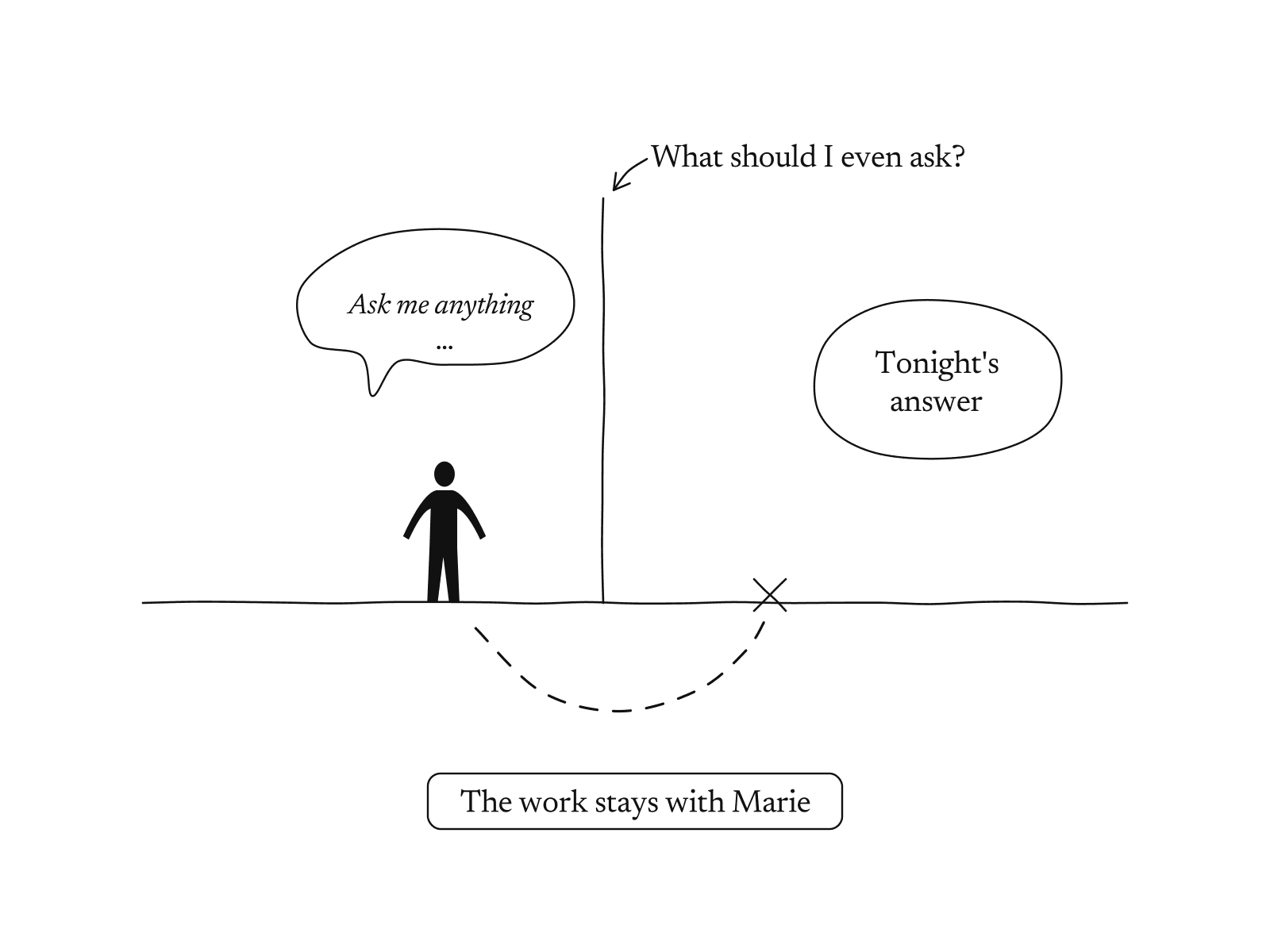
Assistant first
Lead with Sunday’s AI assistant so owners can ask anything. It puts the work back on her: a tired owner doesn’t know what to ask. The system should already know.

KEPT
Three-zone homepage
Verdict, actions, tomorrow, in that order, with the assistant writing the verdict in the background. It answers the three jobs in reading order and keeps the AI where it earns trust.
05 · Structure
Three zones. One reading order.

States and edge cases
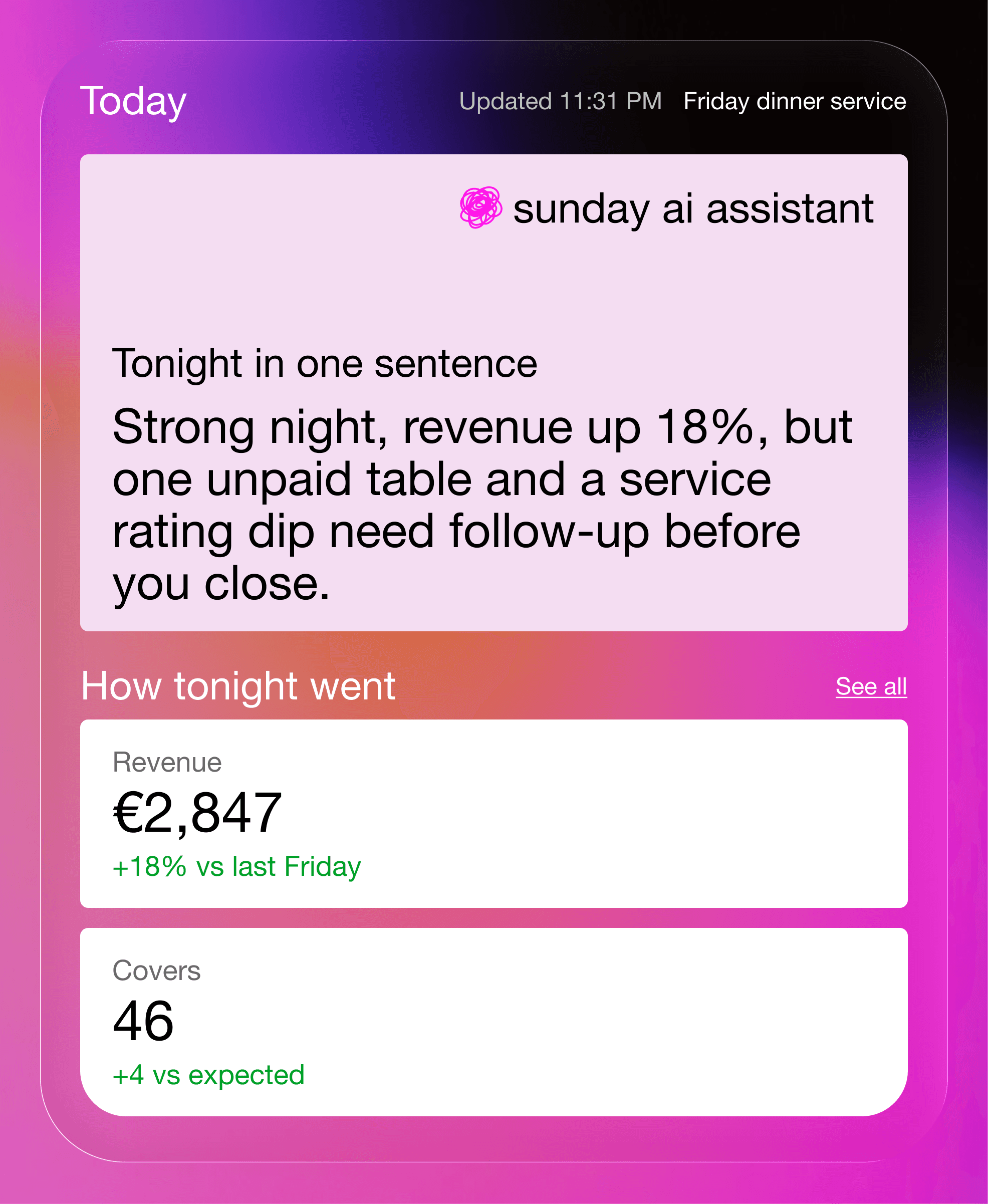
Verdict plus two supporting numbers. Problems are named even on a good night.

Quieter night: revenue down 30% on last Friday, mostly before 8pm. Nothing urgent before you close.

Not enough history to compare. The verdict says so and shows tonight’s totals on their own.

Payments not settled yet. The verdict waits; figures show as provisional with a timestamp.
06 · Solution
06.1
Tonight’s verdict
The first question, answered before she looks for it.
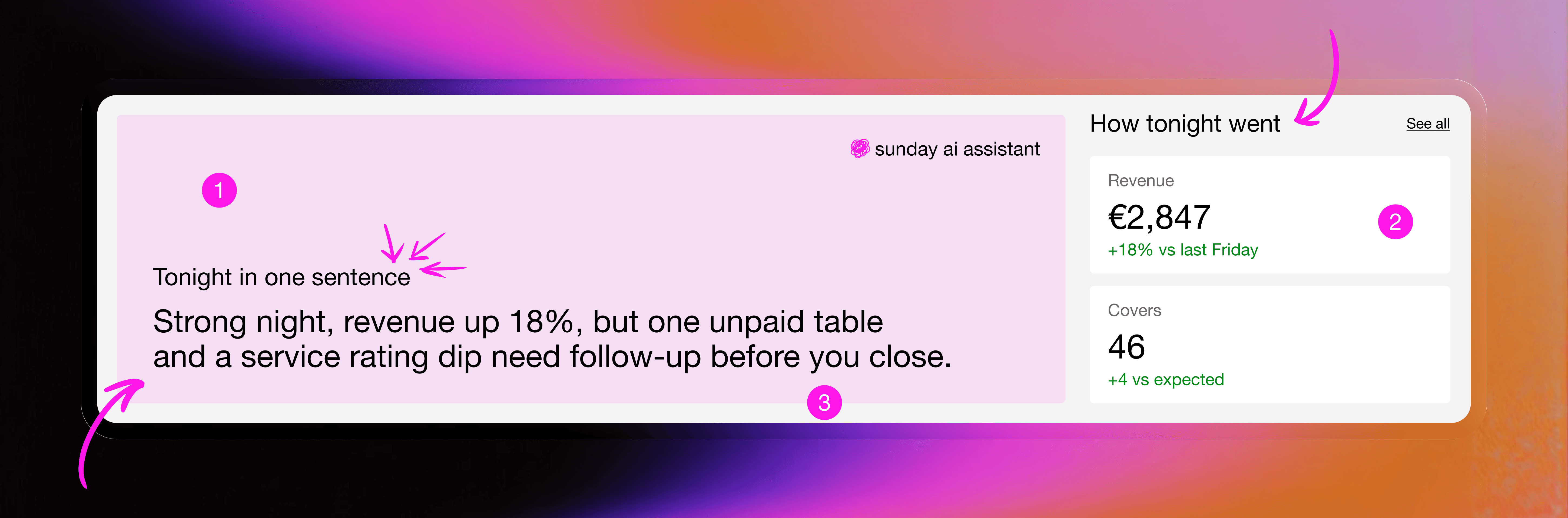

1
A plain-language verdict written by Sunday’s assistant. The system makes the call so Marie doesn’t have to.
2
Only two numbers, revenue and covers, each against a baseline she recognises. Everything else sits one click deeper.
3
The verdict names problems too. A strong night with an unpaid table isn’t a perfect night, and pretending otherwise would cost trust.
06.2
Action items
What needs her before she closes. Nothing that doesn’t.


1
Ranked by urgency, not by category. Red means act now, amber means worth knowing, grey is for information. Each level also has a text label, so colour is never the only signal.
2
One action per card: Resolve, Reply, Mark checked. If the system can’t decide what she should do next, it hasn’t done its job.
3
Every card carries the context to act without digging: the amount, the review quote, when it happened. The 2-star review is tied to the 9pm peak it came from.
06.3
Tomorrow’s focus
One recommendation, specific to tonight.


1
One takeaway, not five. A list of recommendations asks her to prioritise; this one already has.
2
Built from tonight’s data: Saturday’s bookings plus tonight’s slow peak turn time give one concrete thing to brief the team on.
3
Two supporting tips, specific to her restaurant: natural wine pairings added €6 per cover, and Table 7 had the slowest turn at 84 minutes. Not generic advice.
06.4
Before and after
Same navigation. A different job.
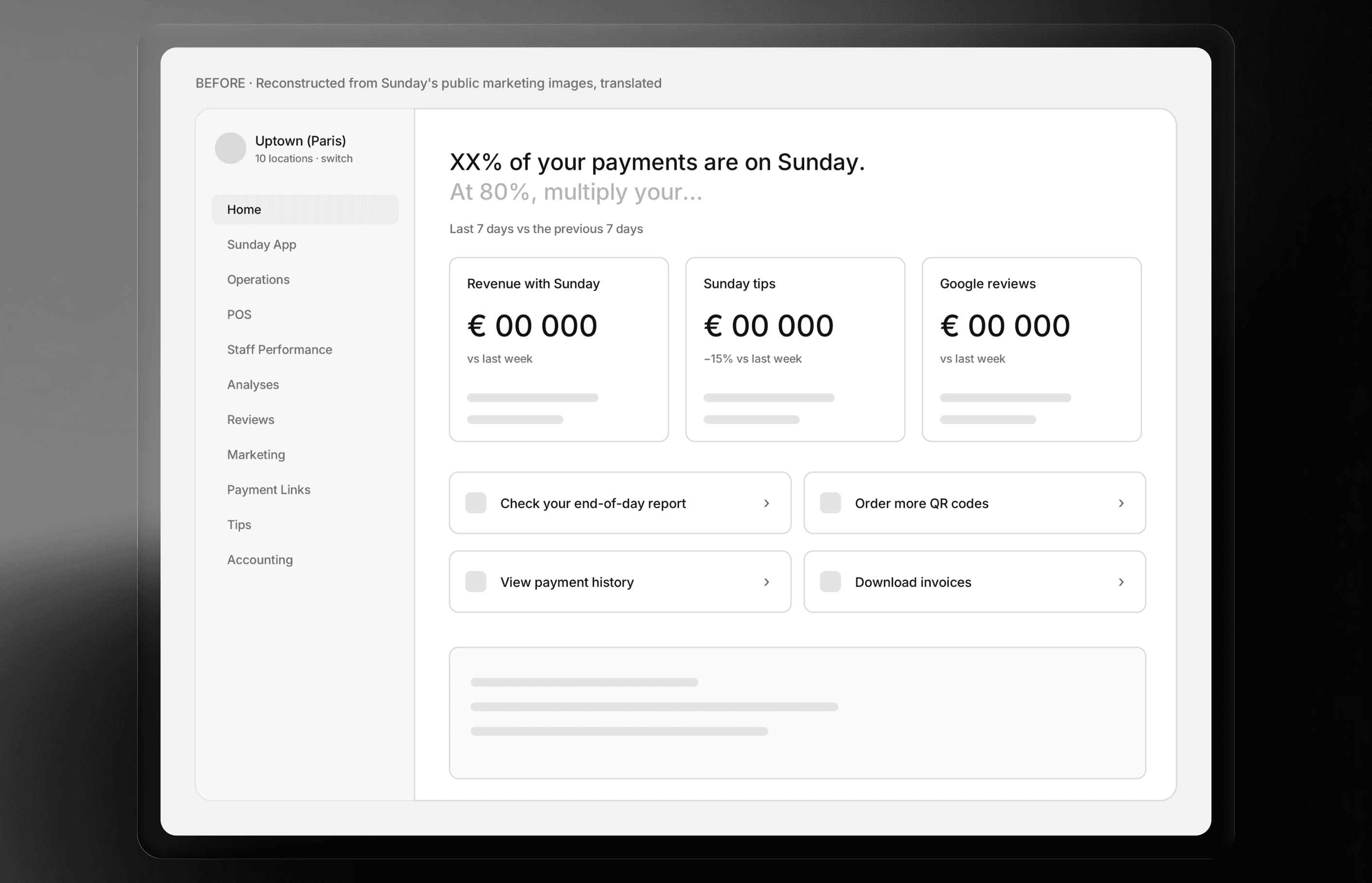
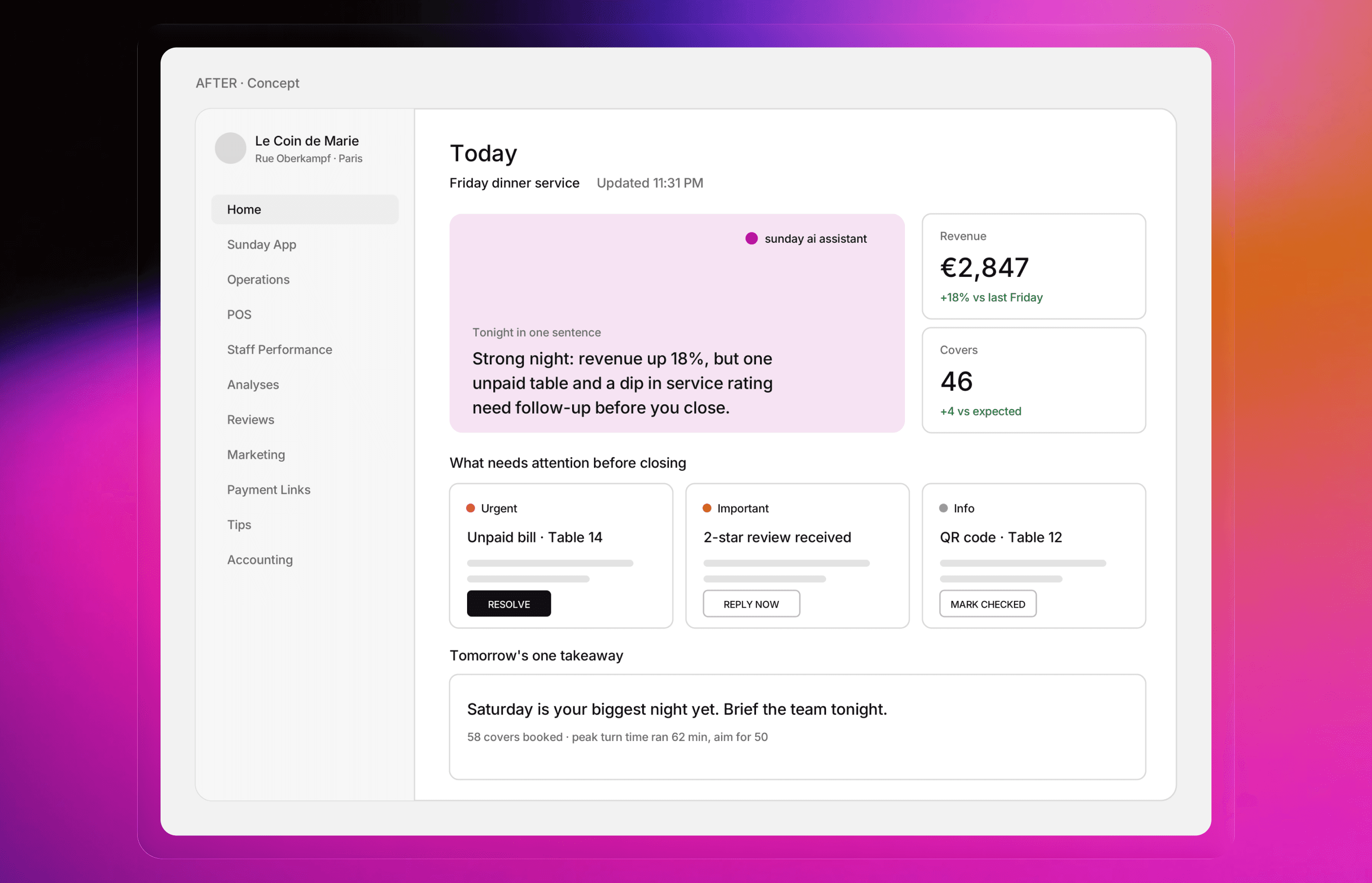
The current homepage is built for a weekly review across several restaurants. This one is built for the nightly close of a single one. Nothing was taken out of the product: the navigation is unchanged, and the homepage now decides what matters tonight, with everything else one click away.
06.5 · See it work
Figma prototype · MUI foundation

From login to closing up: Marie reads the verdict, settles Table 14, replies to the review and leaves a note for Saturday’s team. Under a minute, start to finish.
System
MUI as the foundation, extended to Sunday’s visual language and Marie’s needs: a verdict card, an urgency badge with three levels, an action card with a single button, and the assistant’s entry point in the navigation.

07 · Measuring success
How I would know it works.
North-star
Post-service opens
Share of owners who open the dashboard after close at least three nights a week. A homepage worth opening is the whole bet.
Guardrail
Verdicts flagged as wrong
One wrong “strong night” costs more trust than ten right ones earn. If this rises, the verdict logic gets more cautious.
First test
Verdict by text message
Before building anything, send ten owners a hand-written verdict after service for two weeks. Do they act on it? Do they reply?
08 · Reflection
Trade-offs I made
Opinion over completeness
The homepage hides most of the data. Owners who like to dig lose an overview; “See all” keeps it one click away.
An AI verdict over raw numbers
If the verdict is wrong, trust breaks. That's why two hard numbers sit right next to it: she can check the claim at a glance.
What I would do next
Sit with owners at close
Marie is a hypothesis. I’d spend five evenings with real owners after service to test the three jobs and which action items matter at 11:30pm.
Test which insights get acted on
Tomorrow’s Focus is the most ambitious and least validated zone. I’d test insight types to learn which ones owners act on and which they scroll past.
Credits
Solo design challenge for Sunday, May 2026
Restaurant, persona and figures are illustrative
AI used for sample data and persona imagery